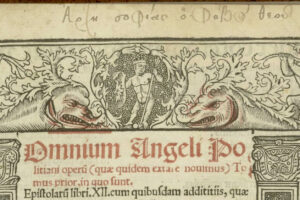
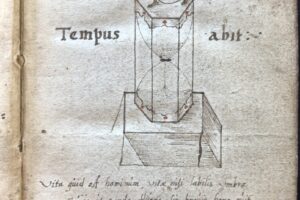
From here, in 1575 Herman Pricker set out on a study trip through Germany, France, and Switzerland. Three years later, he returned to his native Emden, bringing with him an album amicorum (friendship book) filled with writings from fellow students and professors he had met during his travels.


Pricker’s album is a pocket-sized paper booklet in which friends and acquaintances could add their names, sometimes along with one or more quotes and an illustration of their coat of arms. In addition to coats of arms, the album also contains other images, such as a drawing of a mandolin player. The book’s cover suggests that Pricker had acquired it specifically for his study trip: the front bears the initials H.P.F.O., standing for Hermannus Pricker Frisius Orientalis (Herman Pricker from East Frisia), while the back carries the year 1575.
During his travels, Pricker visited several towns that were closely associated with the Reformation. His journey began in Strasbourg in 1575, where he met the East Frisian Ubbo Emmius, who would later become the first chancellor of the University of Groningen. Emmius wrote an account of his own travels, in which he related that, upon his departure, Pricker and other friends hosted a farewell dinner for him, with plenty of drinks flowing.

In early 1577, Pricker left Strasbourg and continued his studies in Basel and Geneva. In Geneva, he met one of the leading figures of Calvinism, Theodorus Beza. Pricker managed to obtain a contribution from Beza for his album. The album also includes a painted portrait of him — one of the more successful likenesses made during Beza’s lifetime.

By mid-1578, Pricker had returned to Emden, where several more friends wrote in his album. This includes Menso Alting, a Reformed minister from Eelde, and Johannes a Lasco, leader of the Lutheran congregation in Emden. Alting’s contribution, dated July 1586, was the last addition to the album made during Pricker’s lifetime. Back home in Emden, Pricker primarily used the album as a souvenir, marking the entries of deceased contributors with crosses. Little is known about the rest of his life. After his death, the album came into the possession of one Conradus Borgert van Asswede, who, in 1653, inscribed a Latin phrase in Zurich in memory of the ‘youth’ Herman Pricker.
The album contains a total of 117 contributions from individuals from Germany, the Netherlands, France, Switzerland, and England. These entries were written in no fewer than seven different languages: Dutch, French, German, Italian, Spanish, Greek, and Latin. Pricker’s album is thus highly multilingual, and many individual contributions reflect this as well. For example, the Frisian Dominicus Richaeus combined an illustration of his coat of arms with Latin quotes from Cicero and Papinianus, a French psalm, and a Greek inscription. The contributions in the album were clearly intended to showcase linguistic and literary knowledge, allowing writers to demonstrate their command of languages and knowledge of canonical literature to future readers.

It is unclear what happened to the album after the seventeenth century. In 1967, the Gockinga family donated it to the University of Groningen Library, where it is currently preserved. It is part of the library’s extensive collection of alba amicorum.
Author: Alisa van de Haar
This publication is part of the project Languages as Lifelines with file number VI.Veni.211F.017 which is financed by the Dutch Research Council (NWO).