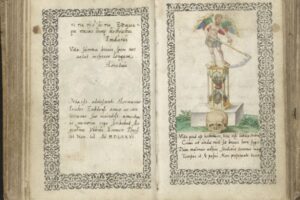
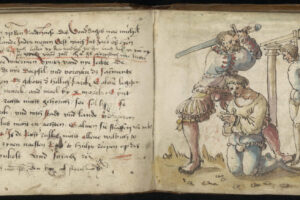
This is where the Abbey Church of the Protestant congregation of Aduard stands. It used to be the infirmary of a monastery. This handwritten chronicle portrays all of its abbots.
The St. Bernard’s monastery was founded in Aduard in 1192. It was the first Cistercian monastery in the Groningen Ommelanden, and one of the largest Cistercian abbeys in all of Europe at its peak. Land ownership was typical of monasteries of this order. Part of their success was due to their economic organization. A monastery not only housed monks or nuns but also lay brothers and sisters who did the daily work on so-called uithoven or voorwerken — the Dutch term for outlying farms connected to the monastery and run by lay people. The Aduard monastery owned a large number of outlying farms.


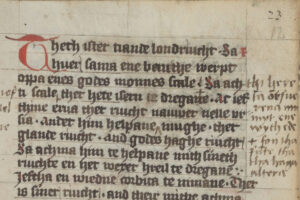
The economic dimension of this monastery is evident in the cartularium of the Aduard zijlvest since the monastery played an important role in the water management of its surroundings. This cartularium was written in 1534 on parchment, as commissioned by Johan Bellinckhoven van Rees. He was the cellerarius (provisions manager) of the monastery and chair of the Aduard zijlvest. The book contains documents from 1382 to 1627, all written in the vernacular. The current gold-tooled leather binding was added in 1600.

Economic prosperity often came hand in hand with spiritual flourishing. In the second half of the 15th century, the Aduard monastery was thriving as a place of learning. Abbot Hendrik van Rees (1449-1485) was a pioneer of intellectual renewal. He hosted a circle of scholars who propagated Italian humanism. Erasmus of Rotterdam later became the figurehead of humanism in the Netherlands, but his inspiration was part of the Aduard circle: Rudolph Agricola from Baflo (1444-1485). Intellectuals from all over Frisia, the Eastern Netherlands, and Westphalia came to Aduard. Here, they inspired each other with the latest knowledge from Italy in the fields of language, ethics, and education. They then spread these ideas through education in the Low Countries and Germany. This is how Erasmus came into contact with these ideas as a pupil at the Latin School in Deventer. One of his teachers there was Alexander Hegius, who was himself a pupil of Agricola.

An important source of our knowledge about humanist Aduard are the letters written by those involved. They wrote to each other, bearing witness to the humanist reading culture that flourished in the monastery. Letters from Agricola to his East Frisian bosom friend Adolf Occo, who studied with him in Ferrara and became town physician in Augsburg, reveal that they both knew classical Greek, which was exceptional even among scholars in their time. Occo had also been in Aduard, as Agricola wrote to him that the abbot was in good health and often reminisced about Occo.
The abbots’ chronicle does not mention the Aduard circle. Apparently, this was not the kind of merit by which the author wished to portray Hendrik van Rees as an abbot. The chronicle gives brief portraits of 34 of the 36 abbots. The monastery was practically dissolved in 1580, when the abbot and monks fled to the Aduard refugium on the Munnekeholm in the city of Groningen. In 1581, the monastery burned down during the Eighty Years’ War. It was formally dissolved in 1595 and rapidly demolished. The village of Aduard was built using the bricks from the monastery. Due to its disastrous end, hardly any books from the monastery have been preserved.


The abbots’ chronicle was written in several phases. The first author portrayed all the abbots up to the end of the 15th century. After that, seven different authors added portraits of abbots from their own time in the 16th century. Eleven handwritten versions of this chronicle have been preserved. The text was printed in 1719. The paper copy at the University of Groningen Library dates from the first half of the 17th century. It includes portraits of all the abbots up to 1578. Around 1775, the Groningen lawyer Hendrik Jan Nauta donated this manuscript to his city’s University Library.
Author: Adrie van der Laan